
Weaving New Livelihoods: Women in Lebanon’s Coastal Communities Learn Fish Net Making

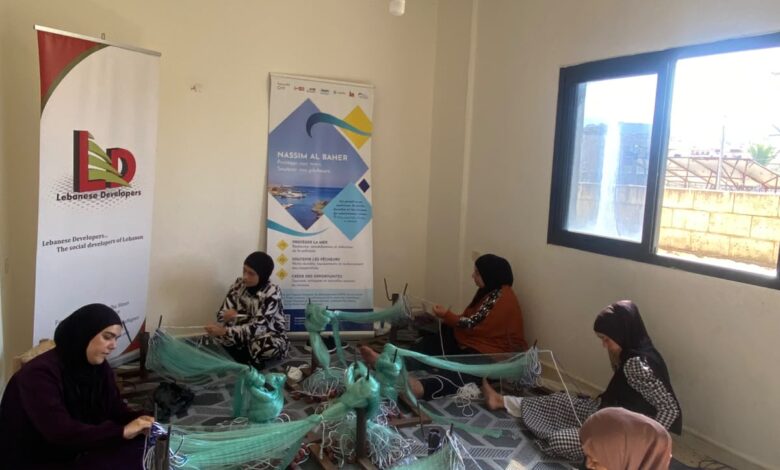
Lebanese Developers trains 10 women in fish net making under the Nassim Al Baher project, funded by the Agence Française de Développement (AFD) and led by Fair Trade Lebanon (FTL).
In Lebanon’s coastal communities, fishing is more than an economic activity: it is a way of life passed down through generations. Yet the sector faces serious pressures, from rising costs and economic crisis to growing environmental threats to the marine ecosystem. Women, although closely tied to fishing households, have long had few chances to take part in the sector’s economy.
To help change this, Lebanese Developers ran a two-month training programme in fish net making for 10 women from coastal communities.
A Project for People and the Sea
The training is part of Nassim Al Baher, a project running from 2025 to 2028. It is funded by the AFD and led by Fair Trade Lebanon, with Lebanese Developers as an implementing partner.
The project has two linked goals:
- to encourage responsible practices in coastal communities that protect marine and coastal ecosystems, through sustainable fishing, eco-responsible tourism and less plastic pollution;
- to improve employability and decent living and working conditions for the people who live along the coast.
The fish net training serves both goals. It gives women a skill that fishermen need, it creates a new source of income, and it strengthens the local fishing economy from within.
Learning by Doing
The programme ran for 24 training days over two months, led by two experienced trainers from Lebanese Developers. Practice came first: each session combined demonstrations, guided exercises and step-by-step skill building, so the women learned with their hands, not only by listening.
The training moved through three stages:
1. Introduction. Participants learned the basic principles of fish net making: the main techniques, the different patterns, and the tools and materials involved. These included nylon netting, cork floats, lead weights, ropes, netting needles, and nylon and silk yarns.
2. Supervised practice. The women started weaving nets themselves under the trainers’ guidance, learning to handle the tools and materials correctly and gaining confidence with each session.
3. Advanced practice. The last stage focused on refining technique, correcting mistakes and improving the quality and consistency of the work, so that each participant could weave on her own.
To make sure every woman could attend regularly, Lebanese Developers covered transport and provided refreshments throughout the training.
Tools to Keep Going
A skill only lasts if it is used. At the end of the training, each participant received her own fish net making kit, so she can keep practising at home, take on orders and build her experience after the programme ends.
I learned the art of fishing net weaving and this will be the carrier of my life to support my family
Alia- Bibnin
What the Training Achieved
By the end of the programme, the participants had:
- gained practical skills in fish net making;
- learned which tools and materials the work requires and how to use them;
- built their confidence and independence through repeated practice;
- developed a skill that can become a source of income;
- made a direct link between their skills and the needs of local fishermen.
Fishermen regularly need new nets and repairs to damaged ones. Local women with these skills can offer a service close to home and add to their household income.
Looking Ahead
The training is a first step. The field observations stress that continued practice, regular follow-up and access to materials are key to keeping and improving the skills the women have gained.
In the coming months, Lebanese Developers and Fair Trade Lebanon plan to:
- follow up with the trained women and support their progress;
- offer more opportunities for practice and skill development;
- connect the women with fishermen and local markets, so their nets reach the people who need them;
- support access to the tools and materials needed to keep working.
Part of a Wider Vision
The training is one part of Lebanese Developers’ commitment to a fairer and more sustainable coastal economy. Under the same project, the organisation will also support the collection of used fishing nets and their recycling into plastic pellets, building on its experience at the port of Abdeh in North Lebanon. Abandoned nylon nets are a major source of marine pollution, and turning them into a resource is a concrete step toward a circular economy.
From weaving new nets to recycling old ones, Nassim Al Baher aims to show that protecting the sea and creating livelihoods can go together.
Nassim Al Baher is funded by the Agence Française de Développement (AFD) and implemented by Fair Trade Lebanon in partnership with Lebanese Developers.


